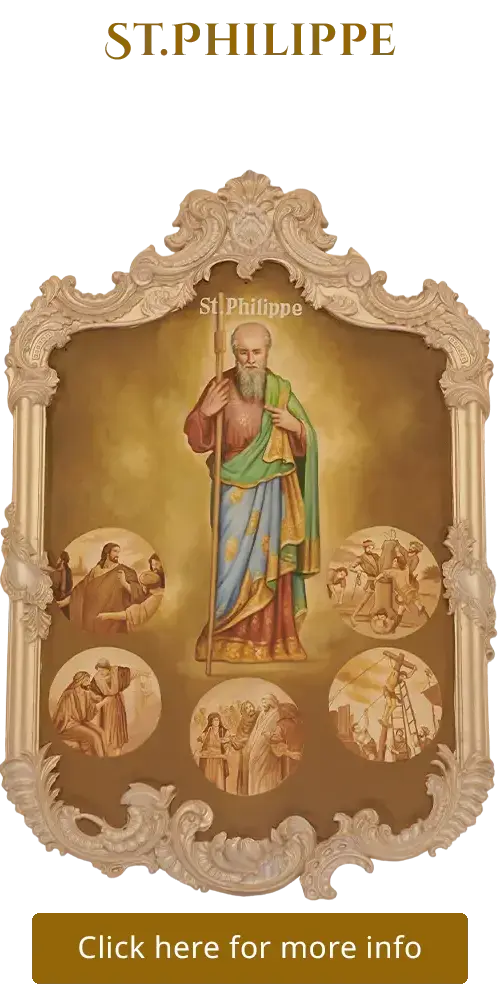
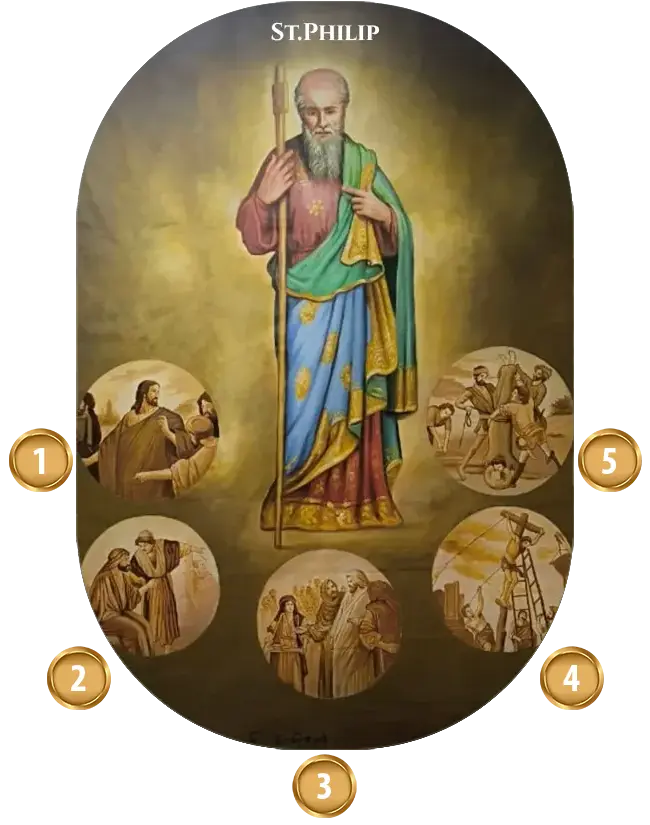
Description: Jesus went to Bethsaida and directly found Philip, issuing the simple command, “Follow me”. Philip’s response was immediate; he followed Jesus without hesitation, demonstrating his willingness to commit to a new path. Philip was from Bethsaida, the same hometown as Peter and Andrew, placing him within Jesus’s expanding network of followers.
Shortly after being called, Philip immediately used his newfound understanding of Jesus to find Nathanael (also identified as Bartholomew) and bring him to Jesus. Nathanael was skeptical, but Philip’s persuasive invitation to “Come and see” proved effective once Nathanael experienced Jesus for himself.
Philip is always listed on the fifth place in the list of apostles.
2. Healing the withered hand of a city official
Historical reference:Acts of Philip.
Description: In Syrian Hierapolis, where pagan temples were abundant, St. Philip the Apostle faced hostility from local Jews, incited by Pharisees, who burned the house of his host, Heros, and sought to kill him. Among them was Aristarchus, a city official, who when attempted to strike the Apostle Philip, his hand immediately withered. After Philip’s prayer, he healed the withered hand. This act of divine power, along with the resurrection of a dead youth, caused Aristarchus and many onlookers to repent and embrace Christianity through holy baptism. This miraculous event was a precursor to other actions by the Apostle Philip in Hierapolis, including preaching the Gospel and the martyrdom of himself and his companions.
3. The Feeding of the Five Thousand
Biblical Reference: John 6:5-14, Matthew 14:13-21, Mark 6:31-44, Luke 9:12-17.
Description: In the miracle of the feeding of the five thousand, St. Philip the Apostle played a notable role. As a large crowd gathered to hear Jesus in a remote area, Jesus turned to Philip, testing him, and asked, “Where shall we buy bread for these people to eat?” Philip, focusing on the practical challenge, replied that even two hundred denarii worth of bread would not suffice for the crowd, highlighting the impossibility of feeding so many with their limited resources.
Jesus, aware of the solution, used Philip’s response to demonstrate His divine power. Taking five barley loaves and two fish from a boy, Jesus blessed them, and miraculously fed the five thousand men (plus women and children), with twelve baskets of leftovers collected afterward. Philip’s practical concern underscored the human limitations contrasted with Jesus’ miraculous provision, reinforcing the disciples’ faith and revealing Jesus as the Bread of Life. This event showcased Philip’s role in the narrative as a disciple grappling with the magnitude of Jesus’ mission.
4. St. Philip’s Question and Jesus’ Revelation of Divine Unity at the Last Supper
Biblical Reference: John 14:8-9
Description: During the Last Supper, Jesus was preparing His disciples for His departure, explaining His oneness with the Father. St. Philip, one of the Twelve Apostles, then asked Jesus, “Lord, show us the Father, and it will be enough for us”. Jesus responded by explaining that anyone who had seen Him had seen the Father, and that the Father was in Him and He was in the Father. He emphasized the deep unity between them, using Philip’s question as an opportunity to further instruct His disciples. Philip’s request provided Jesus with a chance to teach about His divine nature and His perfect unity with the Father.
This moment is a crucial theological statement about the nature of the Son and the Father within the Trinity.
5. Martyrdom of St. Philip
Biblical Reference: Acts of Philippe
Description: After preaching the Gospel across regions like Greece, Phrygia, and Syria, Philip arrived in Hierapolis, a city in modern-day Turkey, around the first century AD. There, alongside his sister Mariamne and the Apostle Bartholomew, he performed miracles, including healing the wife of the city’s proconsul through prayer. This conversion angered the proconsul, who ordered their arrest. The pagan priests, incensed by Philip’s success, demanded his execution.
According to the Acts of Philip, an early non-canonical text, Philip was crucified upside down on a cross, a method intended to mock his faith. Even as he suffered, he continued to preach, and an earthquake struck, terrifying the onlookers. Though some sought to free him, Philip chose to complete his sacrifice, passing into God’s hands around 80 AD. His tomb in Hierapolis later became a place of pilgrimage, with a church built in his honor.